
PRODUCT CATEGORIES – Explore Our Repair Alloy Systems
Forging Die Repair Alloys
Professional repair alloy solutions for forging dies, mold cavities, and high-temperature tooling applications.
Developed to restore damaged areas, resist thermal fatigue, and deliver long-lasting wear protection.
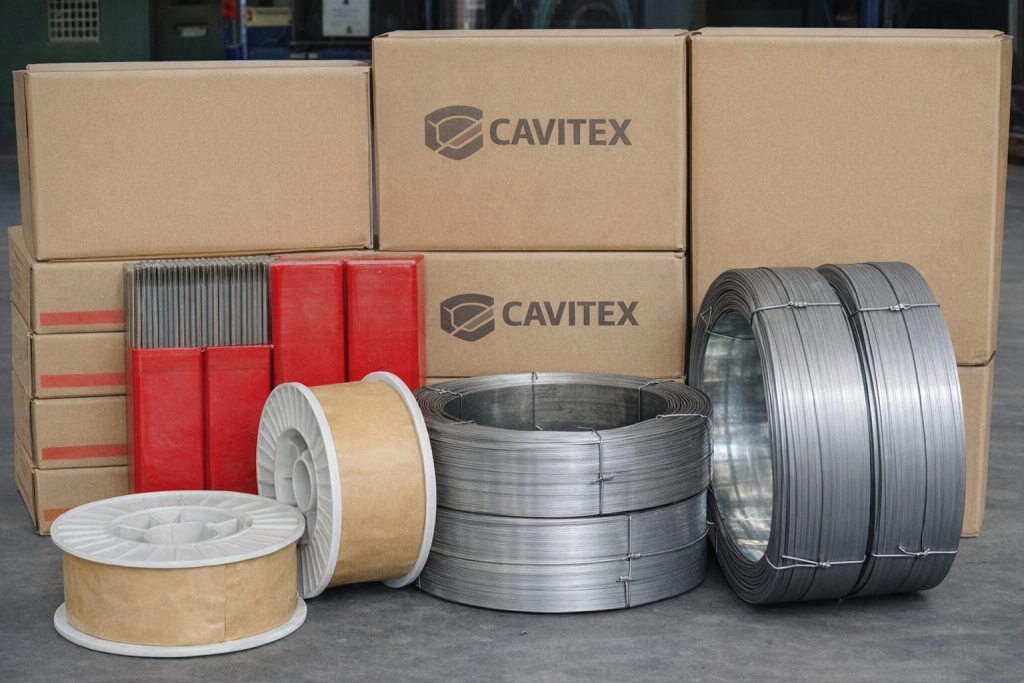
CAVITEX repair alloys – factory packaging
Iron-Based Repair Alloys
Designed for structural repair, crack rebuilding, and base-layer applications in forging dies. These alloys provide excellent toughness and controlled hardness for deep cavity repair.
- Hardness range: 25–45 HRC
- Excellent toughness and crack resistance
- Ideal for deep cavity build-up
- Suitable for buttering layers
A standard welding repair procedure for rebuilding worn or cracked forging die cavities.
Forging dies are exposed to extreme thermal cycles, impact loads, and abrasive wear. A proper repair process is essential to restore cavity geometry, maintain hardness balance, and extend service life.
This guide outlines the typical repair workflow used in professional forging die restoration.
Iron-Based Repair Alloys — Available Models
| Model | Hardness (HRC) | Typical Application |
|---|---|---|
| 3225-FCG/E | 25–30 | High-toughness base-layer welding |
| 3235-FCG/E | 33–38 | Repair of crack-prone structural zones |
| 3240-FCG/E | 40–45 | General forging die rebuild |
| 3245-FCG/E | 40–45 | Cavity hammer die surface layer |
Tool Steel Repair Alloys
Engineered for forging die cavity repair under severe thermal cycling and mechanical stress. These alloys provide hardness compatibility and superior thermal fatigue resistance.
- Hardness range: 42–62 HRC
- Thermal fatigue resistance
- High-temperature strength
- Matching original die hardness
Tool Steel Repair Alloys — Available Models
| Model | Hardness (HRC) | Recommended Application |
|---|---|---|
| 3742-FCG/E | 42–47 | Forging die cavity repair |
| 3747-FCG/E | 46–52 | Deep cavity rebuilding |
| 3750-FCG/E | 46–52 | Medium-depth cavity repair |
| 3752-FCG/E | 46–54 | Thermal fatigue zones |
| 3755-FCG/E | 51–57 | Severe wear areas |
| 3758-FCG/E | 54–60 | High hardness surface layer |
| 3760-FCG/E | 56–62 | Extreme heat & impact zones |
Nickel & Cobalt-Based Alloys
Premium alloy systems designed for extreme heat, oxidation resistance, and severe wear conditions in forging environments.
- Excellent high-temperature stability
- Superior wear resistance
- Oxidation and corrosion resistance
- For demanding forging environments
Nickel-Based Repair Alloys — Available Models
| Model | Hardness (HRC) | Overview & Application |
|---|---|---|
| 3802-FCG | 20–30 | High-toughness nickel-based alloy with excellent thermal shock resistance and oxidation resistance. Suitable for cladding of forging dies. |
| 3808-FCG | 25–30 | Good toughness and thermal fatigue resistance. Ideal for hot trimming dies and extrusion dies. |
| 4606-FAW | 60–62 | High-hardness nickel alloy for precision forging dies requiring strong wear resistance. |
| 4004-FAW | 30–40 | Balanced hardness and toughness. Suitable for general forging die surface welding. |
| 4001-FAW | 40–50 | Excellent wear and thermal shock resistance for forging die rebuilding. |
| 4002-FAW | 50–55 | High-hardness alloy for precision forging dies and surface repair applications. |
| 4008-FAW | 55–60 | Premium wear-resistant nickel alloy for high-temperature forging operations. |
Cobalt-Based Repair Alloys — Available Models
| Model | Hardness (HRC) | Overview & Application |
|---|---|---|
| Co101 | 50–60 | Suitable for rotary seal rings, cone bearing sleeves, drill bits, and severe wear components. |
| Co106 | 40–46 | Used for engine valves, high-temperature sealing surfaces, and turbine blades. |
| Co112 | 44–50 | Suitable for high-temperature valves, shear blades, and thermal shock environments. |
| Co121 | 20–42 | Ideal for fluid valves and hot forging dies under moderate wear conditions. |
| EDCo101 | 50–60 | Hardfacing of components under severe wear and impact, such as valve seats and rotary rings. |
| EDCo106 | 40–46 | High-temperature valves, turbine blades, and hot shear blades. |
| EDCo112 | 44–50 | Excellent scratch and intermetallic wear resistance for high-temperature applications. |
| EDCo121 | 20–42 | Designed for thermal shock and oxidation resistance in extrusion dies and forging dies. |
Not Sure Which Alloy Matches Your Die?
Tell us your base material, hardness requirement, and service conditions. Our engineers will recommend the most suitable repair alloy for your application.